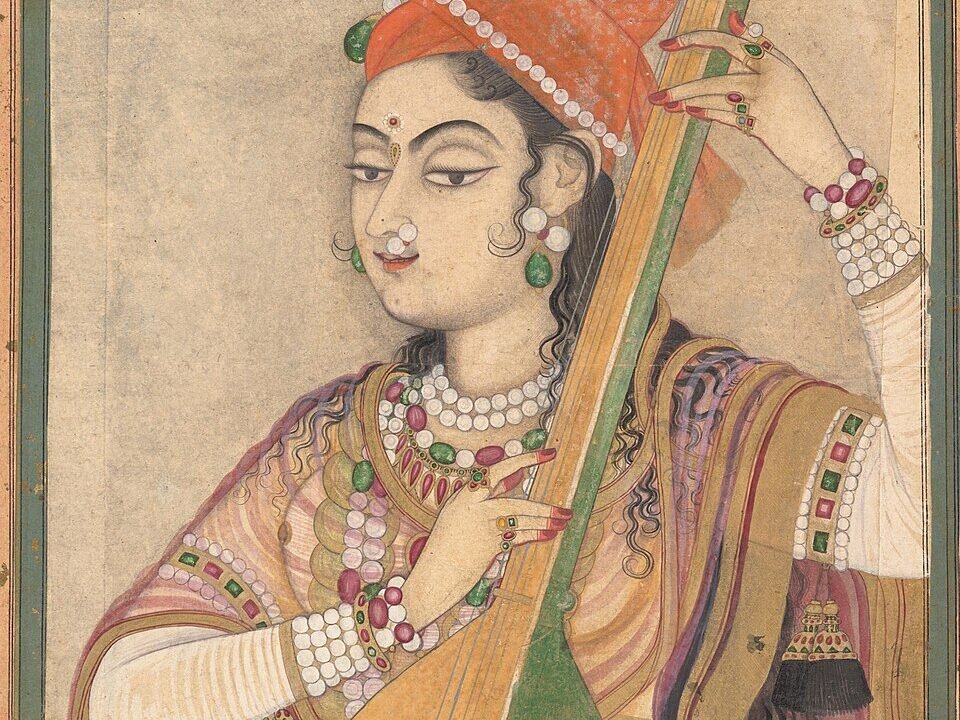
Ask a Hindustani or Carnatic musician what holds their music together and the answer is the same word: raga. A raga is not a song, and it is not quite a scale. It is a framework for creating melody, and it explains why a performance can run for an hour on a single raga without repeating itself. This guide explains what a raga is, what defines one, why many are tied to a time of day, and how the North and South Indian traditions organise them.
What is a raga?
A raga is a melodic framework: a chosen set of notes, characteristic phrases, rules for how the melody ascends and descends, a mood, and often a traditional time of day. The word is commonly explained as related to a Sanskrit word for “colour”, the idea being that a raga colours the mind of the listener.
Two things set a raga apart from a Western scale. First, it has a personality: the same notes can be arranged to sound very different. Second, it comes with rules about which notes are emphasised and how they are approached, so a skilled listener recognises the raga within a few phrases. A raga works alongside a tala, the repeating rhythmic cycle; together, raga (melody) and tala (rhythm) are often described as the two pillars of Indian classical music.
The twelve notes every raga draws from
Indian music names seven main notes, or swaras: Sa, Re, Ga, Ma, Pa, Dha and Ni. They come from a similar set of twelve pitches to those on a Western piano. Sa and Pa are fixed. Re, Ga, Dha and Ni each have a komal (flat) and a shuddha (natural) form, and Ma has a shuddha and a tivra (sharp) form. A raga picks some of these twelve.
What defines a raga?
Choosing notes is only the start. Teachers describe a raga through a set of features:
| Aroha / avaroha | The ascending and descending note patterns, the skeleton of the raga. |
| Vadi | The most important note, sometimes called the “king” note. |
| Samvadi | The second most important note, the “queen” note. |
| Pakad | A signature phrase that identifies the raga. |
| Rasa | The mood the raga is meant to evoke, from Indian aesthetic theory. |
| Samay / prahar | The traditional time of day or season for performing it. |
These features matter because the notes alone do not identify a raga. One educational source points out that Marwa, Puriya and Sohni use identical notes yet sound distinct because their vadi and samvadi differ. A raga is therefore closer to a set of habits and emphases than to a list of pitches. Because of this, performers carry slightly different understandings of the same raga, which is a large part of why Indian classical music is traditionally learned from a teacher rather than from a book.
Why are ragas tied to a time of day?
In Hindustani music, many ragas are associated with a prahar, one of eight three-hour divisions of the day and night. Sources differ on where the count starts: some begin at 7 am, while a teaching resource lists Raga Bhairav in the first prahar, 6 to 9 am. Treat the exact hours as a convention rather than a fixed rule.
Evening concerts are the norm today, so early-morning and afternoon ragas are heard live less often than they once were. The tradition of matching a raga to a time is still taught, and many listeners find that a raga “feels right” at its traditional hour, but it is a custom of performance, not a rule of acoustics.
Hindustani and Carnatic ragas
Both major traditions are built on raga, but they organise their ragas differently:
- Hindustani (North India) groups ragas under ten parent scales called thaats: Bilawal, Kalyan, Khamaj, Bhairav, Poorvi, Marwa, Kafi, Asavari, Bhairavi and Todi. This system was codified by V. N. Bhatkhande.
- Carnatic (South India) uses the melakarta scheme of 72 parent scales, from which thousands of derived (janya) ragas descend.
The two systems overlap more than they differ. Hindustani Raga Yaman and Carnatic Kalyani have nearly identical note structures, and Hindustani Bhairav uses the same swaras as Carnatic Mayamalavagowla. In general, Hindustani music tends to emphasise open-ended improvisation, while Carnatic music places greater weight on set compositions.
How to begin listening
You do not need technical training to enjoy a raga. One practical way to start is to choose a single raga and listen to several different performances of it, so that its character becomes familiar before you compare it with others. Listening for the drone of the tanpura, the main note it returns to, and the recurring phrases that give the raga its identity will take you further than memorising theory first.
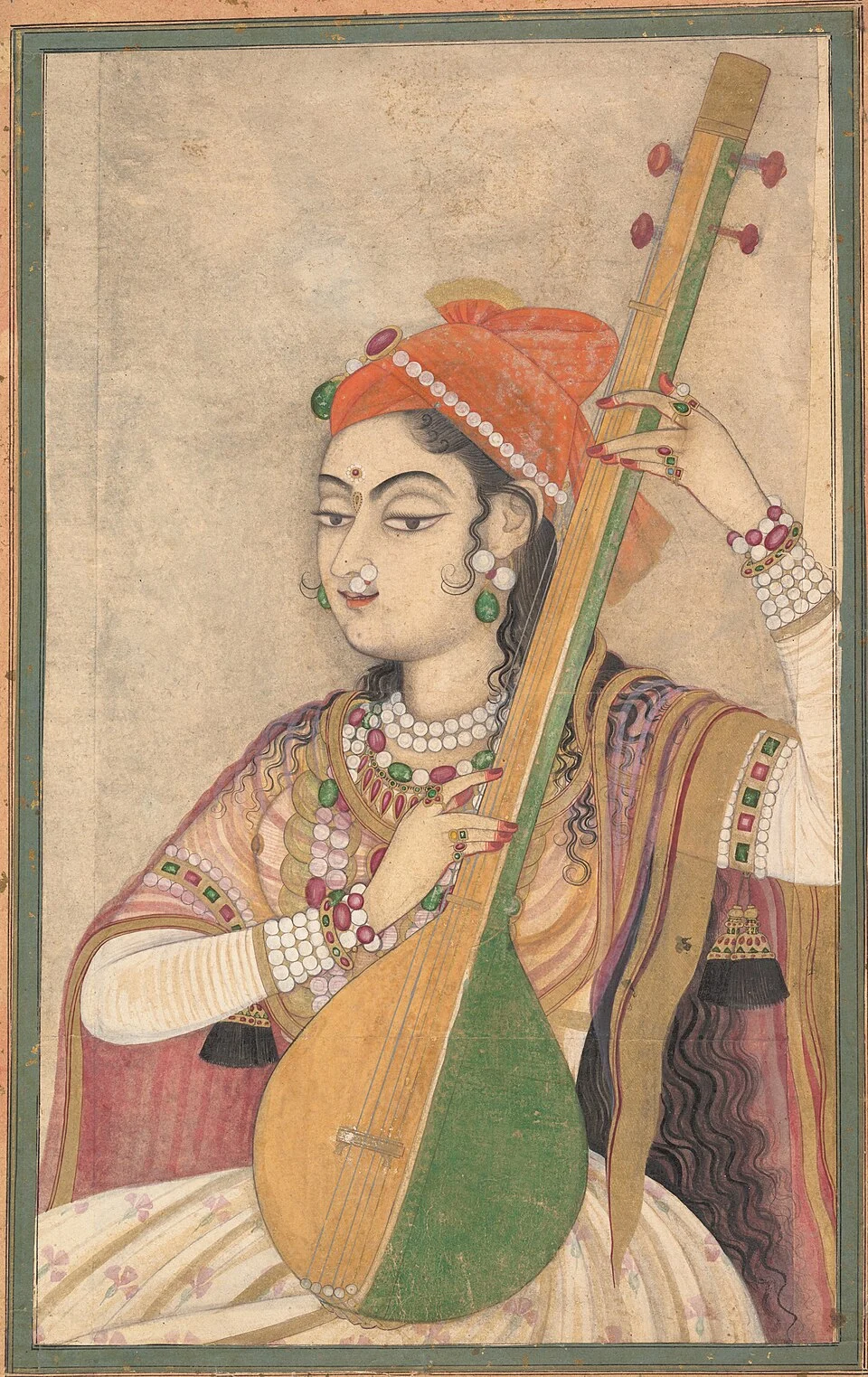
Sources used for this article: Darbar Arts Culture Heritage Trust, “What is Raga?”; iPassio’s raga explainer; indianclassicalmusic.com’s raga framework; Artium Academy’s Hindustani raga reference; Bharat Notes on ragas and talas; and the Oceanofragas concept notes. Where sources differ, the text says so. The painting is from the Metropolitan Museum of Art’s Open Access collection (public domain), and the diagram is original.
Listen: Raag Yaman on the sitar
Frequently asked questions
-
What is a raga in Indian classical music?
A raga is a melodic framework made up of a chosen set of notes, characteristic phrases, rules for ascent and descent, a mood, and often a traditional time of day. It is the foundation of both Hindustani and Carnatic music.
-
Is a raga the same as a scale?
Not quite. A scale lists notes, while a raga also specifies which notes are emphasised, how they are approached, and the phrases that identify it. Different ragas can even share the same notes yet sound different.
-
What are aroha and avaroha?
Aroha is the ascending sequence of notes used in a raga and avaroha is the descending sequence. Together they outline the raga, though much more is needed to perform it faithfully.
-
What do vadi and samvadi mean?
The vadi is the most important note of a raga and the samvadi is the second most important. They help distinguish ragas that use the same set of notes.
-
Do all ragas belong to a time of day?
Many Hindustani ragas are traditionally associated with a prahar (a three-hour division of the day and night) or a season, but the hours are a convention, and modern concerts are mostly held in the evening.
-
How many ragas are there?
There is no single fixed number. Carnatic music organises ragas under 72 parent melakarta scales from which thousands of derived ragas arise, while Hindustani music groups ragas under ten thaats.