The sitar and sarod are plucked string instruments of Hindustani music: the sitar has frets and sympathetic strings, while the sarod is fretless, with a smooth metal fingerboard. The santoor is different: a hammered dulcimer whose strings are struck with light wooden mallets. The santoor comes from Kashmir, and Pandit Shivkumar Sharma is widely credited with making it a solo classical instrument.
Updated 6 October 2026. String counts vary between sources, makers and tunings, so treat the numbers below as approximate.
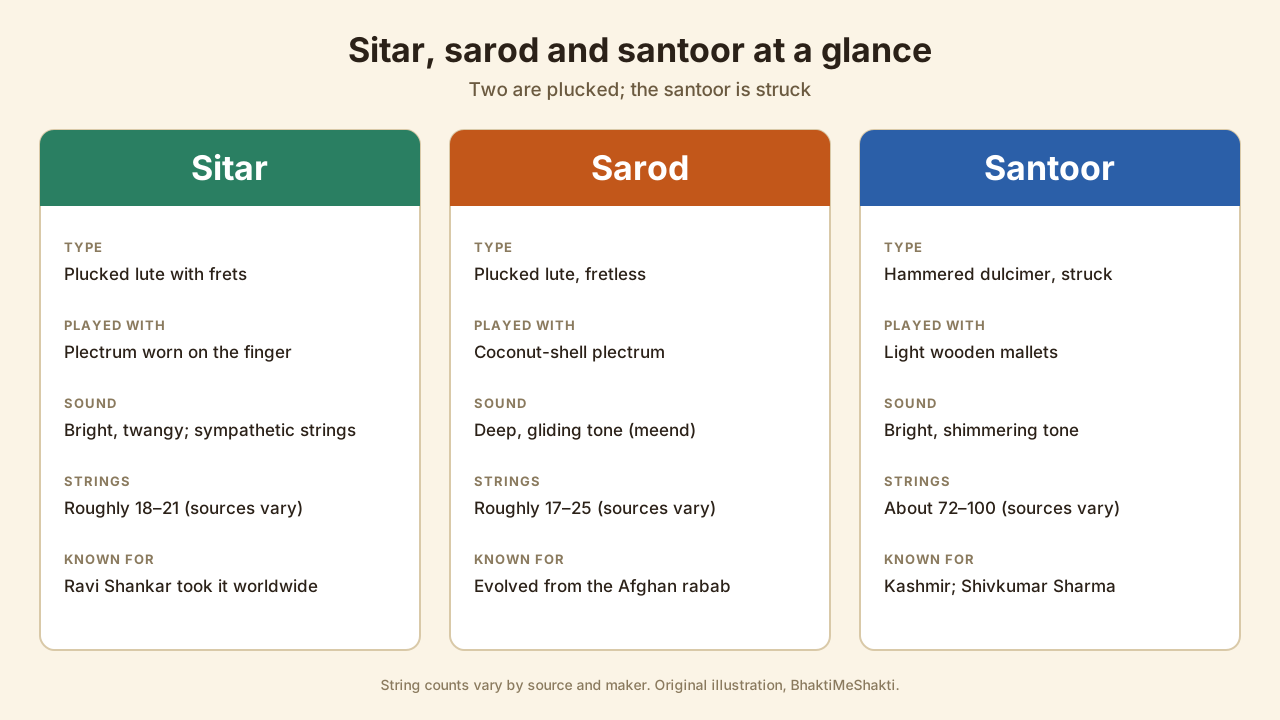
What is the difference between sitar, sarod and santoor?
| Sitar | Sarod | Santoor | |
|---|---|---|---|
| Type | Plucked lute | Plucked lute | Hammered dulcimer (struck) |
| Frets | Yes, movable frets | None; smooth metal fingerboard | None; strings run over bridges |
| Played with | A plectrum worn on the finger | A coconut-shell plectrum | Light wooden mallets |
| Strings | Roughly 18–21 | Roughly 17–25 | About 72–100 |
| Sound | Bright and twangy, with sympathetic shimmer | Deep, introspective, with gliding notes | Bright, shimmering, sustained |
| Origin | Developed in India; some trace it to the ancient veena | Evolved from the Afghan rabab and the sursringar | Kashmir; related to the Iranian santur |
| Associated with | Ravi Shankar | Ali Akbar Khan, Amjad Ali Khan | Shivkumar Sharma |
What is a sitar?
The sitar has a long hollow neck, movable frets and a set of sympathetic strings that vibrate in response to the notes being played, which gives it a distinctive bright, shimmering tone. One guide describes about 20 frets, six or seven main playing strings and nineteen sympathetic strings, while another gives a total of 18 to 21 strings, so counts depend on the instrument and the source. It is played with a plectrum worn on the finger, and its range runs from fast rhythmic runs to deep, expressive glides between notes. Sources differ on its origin: one guide says it developed during the decline of the Mughal Empire, another traces it back to the ancient veena. Ravi Shankar took the sitar to audiences around the world.
What is a sarod?
The sarod is smaller than the sitar and has no frets. Its fingerboard is faced with metal, so players can slide from note to note and produce the continuous bends called meend, which suit slow, contemplative ragas. The name comes from a Persian word for “melody”. The instrument evolved from the Afghan rabab and the older sursringar, and its present form developed roughly 200 to 250 years ago. It is played with a plectrum made from coconut shell. String counts again vary: one guide lists 8 to 10 main strings and 11 to 16 sympathetic ones. Ali Akbar Khan and Amjad Ali Khan are among its best-known masters.
What is a santoor?
The santoor is a trapezoid-shaped hammered dulcimer, a variation of the Iranian santur. Instead of plucking, the player strikes the metal strings with a pair of light wooden mallets. Wikipedia describes the Indian instrument with four strings per bridge for 100 in total, while other guides give around 72 to 90, and the Persian santur typically has 72. In Kashmir it was a traditional instrument used to accompany folk and Sufi music. In the 1950s, Pandit Shivkumar Sharma (1938–2022) adapted it for Hindustani classical music, adding bridges and strings to make it suitable for playing ragas, and is widely credited with turning it into a solo concert instrument.
How can you tell them apart by ear?
- Sitar: a bright, slightly twangy tone, with a shimmer from the sympathetic strings.
- Sarod: a deeper, more introspective sound, with notes that slide and glide.
- Santoor: a sparkling, bell-like sound of struck notes that ring and overlap.
Sitar and sarod are often played together in a jugalbandi (a duet). To hear the sitar in a raga, see our guide to ragas; for how the instruments sit within the tradition, see Hindustani vs Carnatic music and our guide to the tabla, which usually accompanies them.
Sources used for this article: Artium Academy’s santoor guide; Wikipedia’s entries on the Santoor, Sursingar and Jivari; iPassio’s instrument and santoor pages; Culturopedia’s guide to stringed instruments; New Kerala’s guide to string instruments; and Serenade Magazine’s beginner’s guide to Indian classical instruments. Where sources differ, the text says so. The illustration is original.
Frequently asked questions
-
What is the main difference between a sitar and a sarod?
The sitar has movable frets and sympathetic strings, while the sarod is fretless with a smooth metal fingerboard, which lets the player slide between notes.
-
How is the santoor different from the sitar?
The sitar is plucked, whereas the santoor is a hammered dulcimer whose strings are struck with light wooden mallets.
-
Where does the santoor come from?
The santoor is a traditional instrument of Kashmir and a variation of the Iranian santur, where it was used in folk and Sufi music.
-
Who made the santoor a classical solo instrument?
Pandit Shivkumar Sharma (1938–2022) adapted it for Hindustani classical music from the 1950s and is widely credited with making it a solo concert instrument.
-
Which of these instruments has frets?
Only the sitar has frets. The sarod is fretless and the santoor has strings stretched over bridges.
-
How many strings does a sitar, sarod or santoor have?
It varies by instrument and source: roughly 18 to 21 for a sitar, 17 to 25 for a sarod, and about 72 to 100 for a santoor.
-
Where does the sarod come from?
The sarod evolved from the Afghan rabab and the sursringar, and its present form developed roughly 200 to 250 years ago.