India has two great classical music traditions: Hindustani in the north and Carnatic in the south. They share a vocabulary (raga, tala, swara) and a long common history, yet a listener can tell them apart within moments. This guide explains how they split, what actually differs between them, where they overlap, and which popular generalisations are too simple to be useful.
One origin, two paths
Both traditions trace their roots to the same ancient sources, including Sanskrit texts and the Vedic tradition. According to one account, they shared a common history until the late 12th and early 13th centuries, when increasing Persian influence in North India led Hindustani music to develop as a separate tradition. Other sources date the split to around the 14th century, so the exact period is best treated as approximate.
Both are built on the same two ideas: raga, the melodic framework, and tala, the rhythmic cycle. If those terms are new, start with our guide to what a raga is.
Hindustani and Carnatic music at a glance
| Hindustani | Carnatic | |
|---|---|---|
| Region | North India (roughly north of the Vindhyas) | South India (Andhra Pradesh, Karnataka, Kerala, Tamil Nadu) |
| Emphasis | Improvisation; the slow opening elaboration (alap) is central | Compositions; the kriti is the backbone |
| Main vocal forms | Dhrupad, khayal, tarana, thumri, dadra, ghazal | Kriti, varnam, padam, javali |
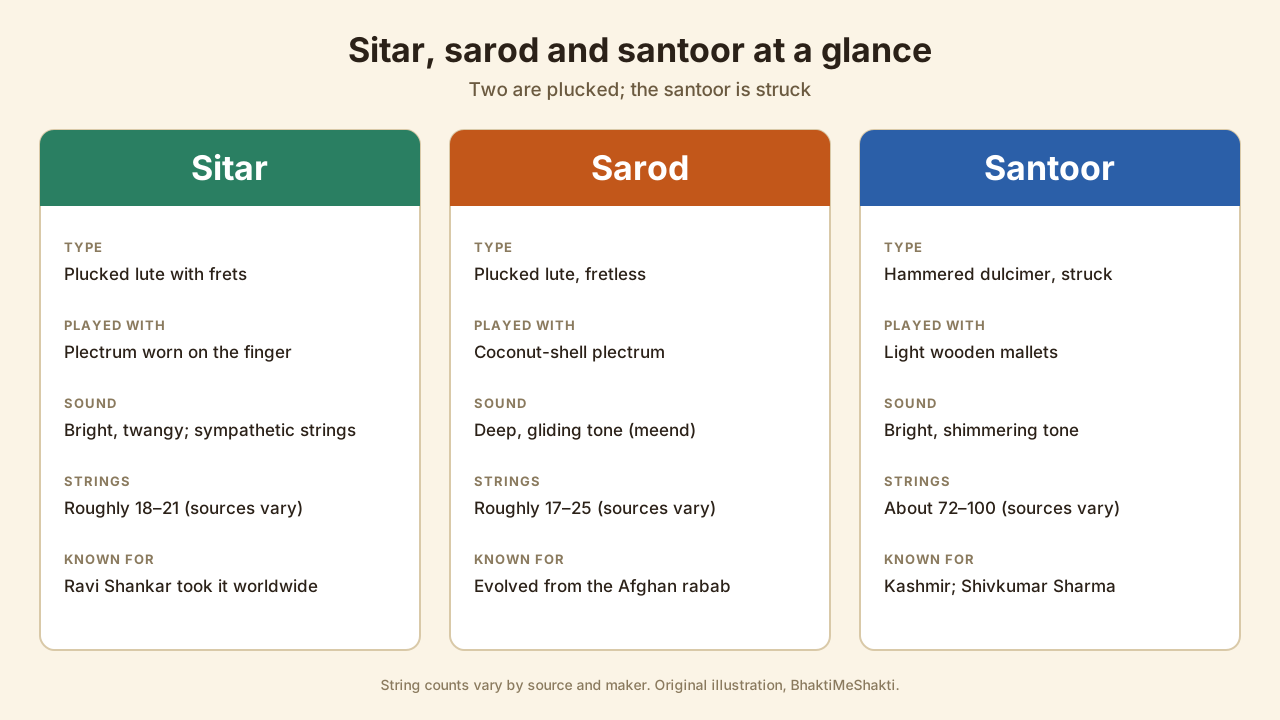
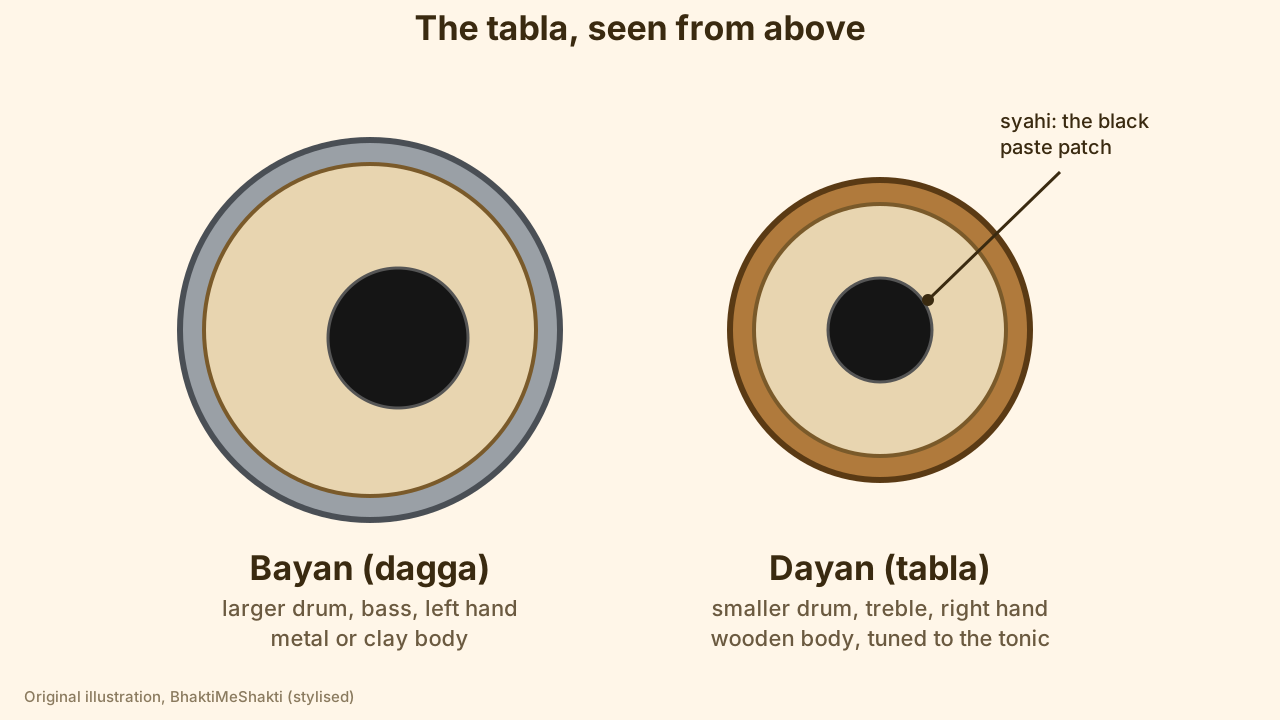
| Typical instruments | Sitar, sarod, sarangi, santoor, flute, tabla | Veena, violin, flute, mridangam, ghatam |
| Parent scale system | Ten thaats | 72 melakartas |
| Outside influence | Persian and Arabic influence after the 13th century | Largely indigenous, though the violin was adopted in the late 18th century |
Treat this table as a guide to emphasis, not a set of absolutes. Individual musicians and schools cross these lines all the time.
Improvisation versus composition
The most commonly cited difference is balance. Hindustani music places more weight on improvisation. A khayal performance typically moves from a slow, expansive section (bada khayal) to a faster one (chhota khayal), and the soloist has wide freedom to elaborate the raga in the moment. Hindustani music also has gharanas, distinct schools or stylistic lineages.
Carnatic music is taught and learned largely through compositions. The kriti, a structured devotional composition in three parts, is the core of a concert, and most compositions are written to be sung, even when played on instruments. But this does not mean Carnatic music lacks improvisation. Forms such as alapana (free exploration of the raga), niraval and kalpanaswaram are improvised within the structure. A fair summary is that Carnatic music improvises within a composition, while Hindustani music tends to treat the composition as a starting point.
What a concert looks like
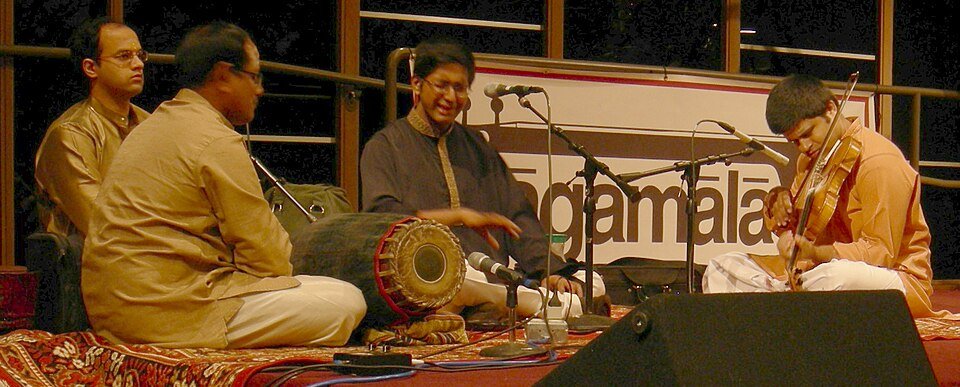
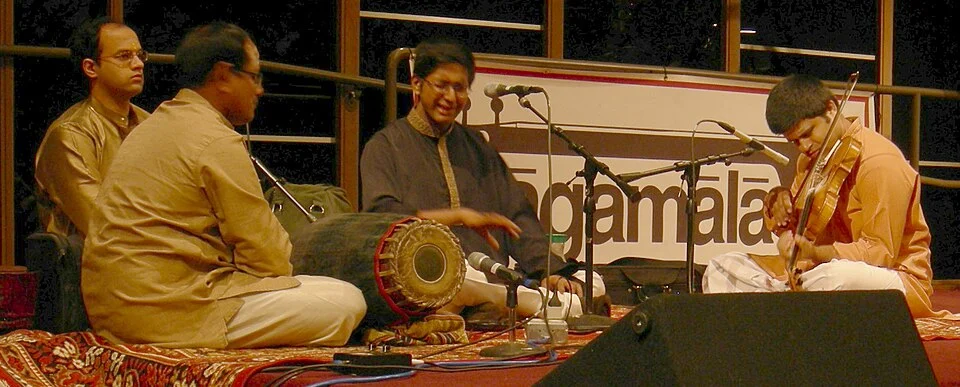
A Carnatic concert, called a kutcheri, runs for about two and a half hours. According to Sruti magazine, a standard minimum ensemble is a lead voice or instrument, a violin and a mridangam, often joined by the ghatam or kanjira. Many of the songs praise Hindu deities, and compositions are most often in Sanskrit, Telugu, Tamil or Kannada. The tradition originated as temple music and was supported by royal patronage before moving to the concert stage.
Hindustani music, by contrast, evolved under the Persian influence mentioned above, which brought new instruments and styles; Amir Khusrau is often credited as a figure who blended Indian and Persian music, although historians contest the popular claims that he invented the sitar or tabla.
Where the two traditions meet
The overlap is substantial. Several ragas appear in both systems under different names with the same or nearly the same notes: Hindustani Yaman corresponds to Carnatic Kalyani, and Hindustani Bhairav to Carnatic Mayamalavagowla. Both traditions also share the belief that a raga is not invented by its performer.
Oversimplifications to avoid
- “Carnatic is mathematical, Hindustani is emotional.” Both traditions are rigorous and both aim at emotional expression; this framing reflects listener impressions more than a real divide.
- “Carnatic music has no improvisation.” It does, within defined forms, as described above.
- “One is older or purer.” Sources do not agree on which is older, and the account above has them growing out of a shared past.
A good way to hear the difference
Because Yaman and Kalyani share their notes, they make a useful listening experiment: find a Hindustani performance of Yaman and a Carnatic performance of Kalyani and compare how each unfolds. The notes are the same, but the pacing, ornamentation and balance between composition and improvisation differ, which is exactly what separates the two traditions.
Sources used for this article: New World Encyclopedia’s entry on Carnatic music; Artium Academy’s Carnatic versus Hindustani comparison; ClearIAS and Vajiram & Ravi’s overviews of Indian classical music; Anantam IAS’s comparison; Sruti magazine’s pocket guide to the Carnatic concert; and a theatre programme note on the mridangam and the violin in Carnatic music. Where sources disagree, the text says so. The photograph is used under a Creative Commons licence with credit shown beneath it.
Listen: a Hindustani Raag Yaman
Frequently asked questions
-
What is the main difference between Hindustani and Carnatic music?
Hindustani music, from North India, places more emphasis on improvisation, while Carnatic music, from South India, is built more around fixed compositions called kritis. Both use raga and tala, and both allow improvisation to different degrees.
-
When did Hindustani and Carnatic music separate?
One account says they shared a common history until the late 12th and early 13th centuries, when Persian influence in North India led Hindustani music to develop separately. Other sources place the division around the 14th century, so the date is approximate.
-
Which instruments are used in each tradition?
Hindustani music commonly uses the sitar, sarod, sarangi, santoor, flute and tabla. Carnatic music commonly uses the veena, violin, flute, mridangam and ghatam.
-
Does Carnatic music have improvisation?
Yes. Forms such as alapana, niraval and kalpanaswaram are improvised within the structure of the tradition, though compositions are given more weight than in Hindustani music.
-
What are thaats and melakartas?
Thaats and melakartas are the parent scale systems of the two traditions. Hindustani music groups ragas under ten thaats, while Carnatic music uses 72 melakarta parent scales from which many derived ragas descend.
-
Are any ragas shared between the two traditions?
Yes. For example, Hindustani Yaman corresponds to Carnatic Kalyani, and Hindustani Bhairav to Carnatic Mayamalavagowla, with the same or nearly the same notes.