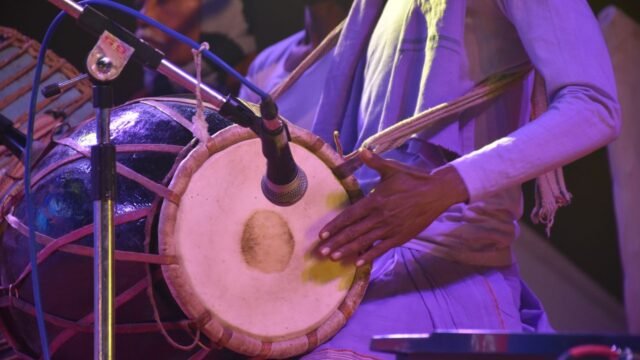
The tabla is a pair of hand drums at the heart of Hindustani music: the smaller wooden dayan, played with the right hand for treble tones, and the larger bayan (or dagga), played with the left hand for bass. Players learn it through spoken syllables called bols. Its origin is debated: the popular story that Amir Khusrau split a pakhawaj in two is treated by scholars as legend, and the reliable evidence points to the 18th century.
Updated 6 October 2026.
The tabla at a glance
| The two drums | Dayan (also called the tabla itself) and bayan (also called dagga) |
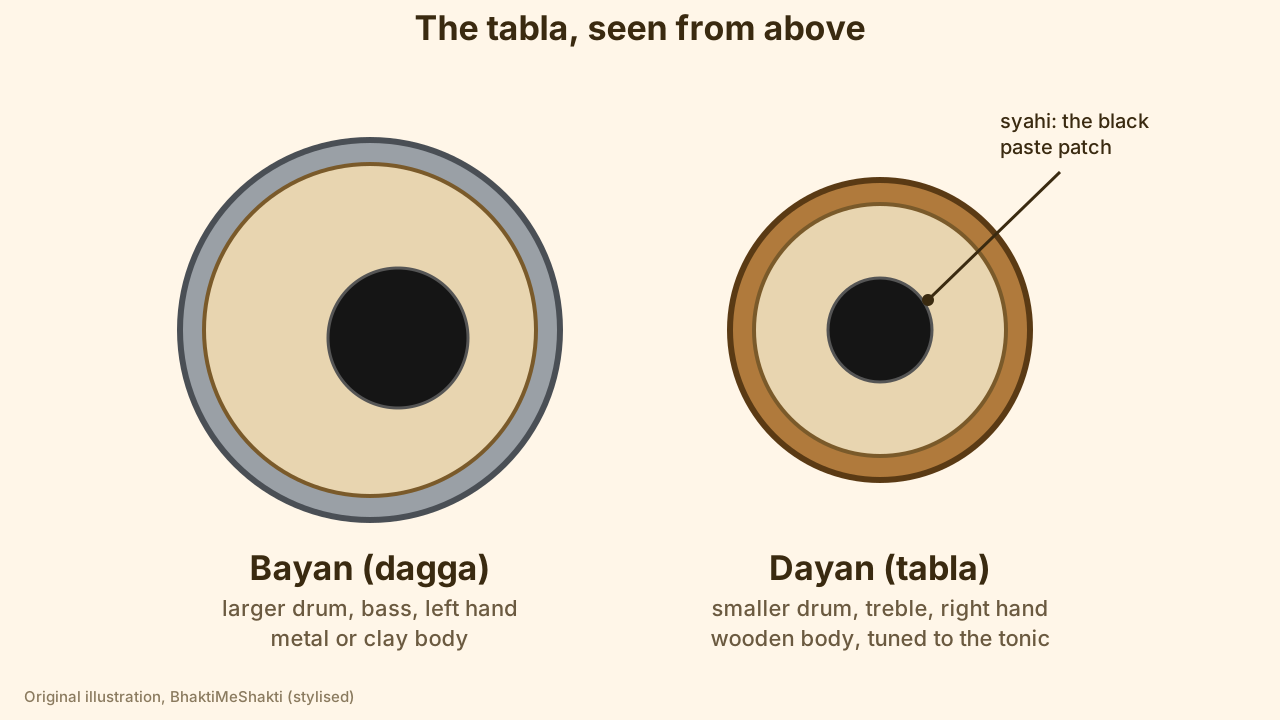
| Dayan | Smaller, wooden, right hand, treble, tuned to the tonic |
| Bayan | Larger, metal or clay, left hand, bass |
| Learned through | Spoken syllables called bols |
| Schools | Six main gharanas: Delhi, Ajrara, Lucknow, Farrukhabad, Benares and Punjab |
| Common taals | Teentaal (16 beats), jhaptaal (10), ektaal (12), rupak (7) |
| Role | Accompanies vocal, instrumental and Kathak performances, and also has a solo tradition |
What are the parts of a tabla?
The word tabla is usually traced to an Arabic-Persian word for “drum”, and musicians often call the pair tabla-bayan. The smaller right-hand drum, the dayan, produces treble and tonal sounds and is tuned to the tonic of the music. The larger left-hand drum, the bayan or dagga, mainly produces bass and has a metal or clay body. Each drumhead carries a patch of black paste called syahi. Players sit cross-legged, although some from Benares have traditionally kept an older kneeling position.
Who invented the tabla?
Nobody knows for certain. Musicologist Vijay Shanker Mishra calls the tabla’s origin one of the most controversial aspects of Indian classical music. The main accounts are:
- The Amir Khusrau story. A widely told account credits the 13th-century poet-musician Amir Khusrau (1253–1325) with splitting a pakhawaj into two to make the tabla. Scholars Neil Sorrell and Ram Narayan say this legend “cannot be given any credence”, and most musicologists treat it as unproven.
- The court-rivalry story. In another legend, a defeated pakhawaj player, Sudhar Khan Dhadhi, smashed his drum in two in the court of Muhammad Shah Rangeela in the 18th century and began playing the halves.
- The “ancient” theory. Some accounts say the tabla is thousands of years old, but New World Encyclopedia calls this conjecture based on careless readings of iconography, although the earliest evidence does trace the instrument’s evolution from older indigenous drums.
- The evidence-based view. The classical tabla tradition most likely begins in the 1700s, and the first verifiable great player is Ustad Siddhar Khan of Delhi. Darbar also notes the tabla is believed to have originated in the 18th century and evolved from earlier drums such as the pakhawaj.
What are the tabla gharanas?
A gharana is a lineage school with its own technique, hand positions and repertoire, passed from teacher to student. Six are widely recognised: Delhi, Ajrara, Lucknow, Farrukhabad, Benares (Banaras) and Punjab. Delhi and Lucknow came first. According to one history, Ajrara is closely based on Delhi, while Farrukhabad and Benares are more closely based on Lucknow, and the Punjab gharana developed more independently, influenced by its own regional drumming traditions. The Lucknow gharana developed under the patronage of the nawabs of Awadh.
How is the tabla played?
Tabla compositions are built from bols, spoken syllables that stand for particular strokes, and players use intricate finger techniques to build patterns that can be both highly structured and deeply improvisational. These patterns are set within a taal, a repeating rhythmic cycle, such as the 16-beat teentaal.
For most of its history the tabla was an accompanying instrument. Ustad Ahmed Jan Thirakwa is credited with making history by playing it as a solo instrument at a time when it was only accepted as an accompanist, and the dual-solo format was popularised by players including Alla Rakha and his son Zakir Hussain (1951–2024), widely regarded as the greatest tabla player of his generation. For the rhythmic and melodic ideas the tabla works within, see our guides to ragas and to Hindustani and Carnatic music.
Watch: two tabla masters duel over teentaal
Sources used for this article: Wikipedia’s entries on Tabla, Zakir Hussain, Ahmed Jan Thirakwa and Taranath Rao; New World Encyclopedia’s entry on the tabla; Darbar’s tabla page; the Model Diplomat glossary entry; Kalasudha’s instrument profile; DigiTabla’s “A Brief History of the Tabla”; Siasat’s report on the tabla’s origin stories; and Prof. Sudhir Kumar Varma’s “The Art of Tabla Playing”. Where sources differ, the text says so. The illustration is original.
Frequently asked questions
-
What are the two drums of the tabla called?
The smaller right-hand drum is the dayan (also called the tabla), and the larger left-hand drum is the bayan, also called the dagga.
-
Who invented the tabla?
Its origin is debated. A popular legend credits Amir Khusrau with splitting a pakhawaj in two, but most scholars treat this as unproven, and the reliable evidence places the classical tabla in the 18th century.
-
What is the syahi on a tabla?
The syahi is the patch of black paste on the drumhead.
-
What are bols?
Bols are spoken syllables that stand for particular tabla strokes. Compositions are learned and taught through them.
-
What are the main tabla gharanas?
Six are widely recognised: Delhi, Ajrara, Lucknow, Farrukhabad, Benares and Punjab.
-
How many beats are in teentaal?
Teentaal has 16 beats. Other common taals include ektaal (12 beats), jhaptaal (10) and rupak (7).
-
Can the tabla be played solo?
Yes. Although it was long an accompanying instrument, it now has a solo tradition, popularised by masters such as Ahmed Jan Thirakwa, Alla Rakha and Zakir Hussain.