Rangoli is the Indian art of drawing patterns on the floor at the entrance of a home, using rice flour, coloured powder, flower petals or sand. Kolam is the Tamil Nadu form: usually white rice flour drawn in looping lines around a grid of dots called pulli. Both welcome guests and, at Diwali, the goddess Lakshmi. Diwali 2026 falls on Sunday 8 November.
Updated 6 October 2026.
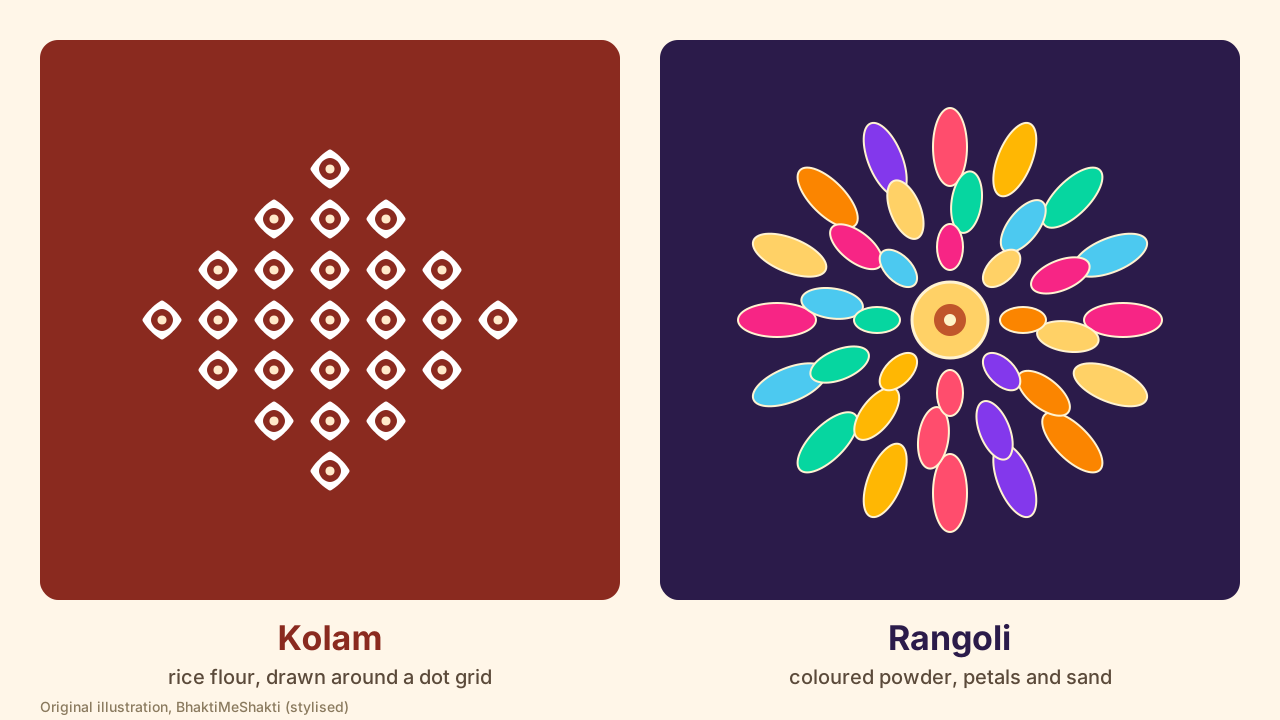
What is the difference between rangoli and kolam?
| Rangoli | Kolam | |
|---|---|---|
| Meaning | The broad term used across India | The Tamil Nadu version (also known as muggu in Andhra Pradesh and Telangana) |
| Materials | Rice flour, coloured powder, flower petals, coloured sand; in North India often gypsum-based powder | Traditionally dry rice flour (kolapodi); a dilute rice paste or paint is sometimes used to last longer |
| Look | Often filled with colour; North Indian rangoli tends toward bold colour and symmetry | Linear and mostly white; prizes symmetry, precision and intricacy |
| Method | Freehand, stencils or a grid | A grid of dots (pulli) encircled, looped or joined by lines |
| When | Festivals, and daily in many homes | Drawn every day at dawn in many households |
What is rangoli called in different states?
- Kolam: Tamil Nadu
- Muggu: Andhra Pradesh and Telangana
- Rangole (and hase): Karnataka
- Raangolee: Maharashtra
- Alpana (alpona): West Bengal
- Aripana (aripan): Bihar and Mithila
- Mandana: Rajasthan and Madhya Pradesh, where designs are also painted on walls and courtyards
- Chowkpurana: Uttar Pradesh
- Chaook: Chhattisgarh
Materials and motifs vary, but the idea is shared: a pattern drawn at the threshold that is cleaned away and redrawn. Onam rangoli, for example, are typically made of flowers.
Why is rangoli drawn at the doorway?
The doorway is where Lakshmi is understood to enter, so the pattern works as an invitation, which is why rangoli is central to Diwali. One guide notes that rangoli is offered to Lakshmi at Diwali, to the sun during Pongal and to ancestors during shraddha rituals. In Tamil Nadu, the month of Margazhi (December to January) carries special significance for kolam.
Impermanence is part of the meaning: each day the previous day’s pattern is cleaned away and a new one takes its place, which writers link to the Hindu view of the impermanent body. Some households also associate the kolam and its red border (kaavi) with keeping unwanted influences out; this is a traditional belief rather than a measurable effect.
How is a kolam drawn?
According to Sahapedia, kolam patterns are drawn with the fingertips, letting a pinch of flour held between the thumb and forefinger fall in a continuous line as the hand moves. The patterns are based on a grid of pullis that are encircled, looped or joined with straight or curved lines. A surface that is wetted first holds the powder better.
Sahapedia describes three rules for the “knotted” kolam, where one line loops around the dots: every line orbit must be closed, every dot must be encircled, and no two lines may overlap along any length. Wikipedia adds that the line typically runs once around each dot and returns to its starting point, forming a mostly geometric figure.
Easy rangoli ideas for Diwali 2026
- Classic Diwali motifs: the diya, Ganesha, Lakshmi, flowers and birds are common choices.
- Start with chalk or flour outlines: sketch a circle, lotus or diya, then fill the spaces with colour.
- Try a dot grid: mark a small grid of dots and loop a line around them, kolam-style, for a clean geometric design.
- Use petals: flower-petal rangoli, often outlined in white rice flour, is a simple way to avoid coloured powders.
- Add lamps: it is common to place oil lamps within the rangoli at Diwali.
When is Diwali 2026?
Diwali 2026 falls on Sunday 8 November, the main night of the five-day festival, when Lakshmi Puja is performed. The auspicious evening time depends on your city. Drik Panchang lists about 6:23 pm to 8:24 pm for Coimbatore, for example, so check the listing for your own location.
Sources used for this article: Wikipedia’s entries on Kolam and Rangoli; Sahapedia’s “Significance of Kolam in Tamil Culture” and “Kolam: When Hands are Drawing”; DSource’s page on kolam; Sacredcal’s Diwali 2026 guide; Drik Panchang’s 2026 Lakshmi Puja timings; and festival guides from diwali.info and rangolidesigns.org. Where sources differ, the text says so. The illustration is original and stylised.
Watch: a beginner kolam demonstration
Frequently asked questions
-
What is the difference between rangoli and kolam?
Rangoli is the general term for floor patterns drawn across India with rice flour, coloured powder, petals or sand. Kolam is the Tamil Nadu form, usually white rice flour in looping lines around a grid of dots.
-
What is a pulli kolam?
A pulli kolam is drawn around a grid of dots (pulli). A line loops around each dot and returns to its start, forming a mostly geometric pattern.
-
What are the other names for rangoli?
Kolam in Tamil Nadu, muggu in Andhra Pradesh and Telangana, alpana in West Bengal, aripana in Bihar, mandana in Rajasthan and Madhya Pradesh, and chowkpurana in Uttar Pradesh.
-
Why is rangoli drawn at the entrance?
The doorway is where the goddess Lakshmi is understood to enter, so the pattern works as a welcome and an invitation, especially at Diwali.
-
What materials are used for rangoli?
Traditionally rice flour, dry coloured powder, flower petals and coloured sand. In North India, gypsum-based powder is common; kolam typically uses rice flour.
-
What are the rules of a knotted kolam?
According to Sahapedia, every line orbit must be closed, every dot must be encircled, and no two lines may overlap along any length.
-
When is Diwali 2026?
Diwali 2026 falls on Sunday 8 November. The Lakshmi Puja time depends on your city, so check a local panchang.