Hampi, in Karnataka, is what remains of Vijayanagara, the capital of one of South India’s most powerful empires. Temples, bazaars, royal enclosures and water works are scattered across a boulder-strewn landscape beside the Tungabhadra river. It is a World Heritage Site, and it is large enough that how you group the sights matters more than how many you try to see. This guide explains what Hampi is, how to reach it, when to go, and one practical way to organise three days.
Hampi at a glance
| Location | Karnataka, on the Tungabhadra river, near the town of Hosapete (Hospet) |
| What it was | Capital of the Vijayanagara Empire, a medieval South Indian empire (14th–16th centuries) |
| World Heritage status | Inscribed in 1986 as the “Group of Monuments at Hampi” |
| Scale | More than 1,600 surviving remains over roughly 4,100 hectares, as cited by one travel guide quoting UNESCO |
| Best months | October to February or March |
| Suggested time | Three days for a first visit |
Why Hampi matters
Vijayanagara was among the richest cities of its time. One guide dates the capital to 1336–1565; most accounts simply place its height in the 14th to 16th centuries. What visitors see today is the monumental core: temples, markets, fortifications, palaces and stables. That variety is Hampi’s appeal. It is not one monument but a whole city, and you can read how it was organised, from the sacred centre around the Virupaksha Temple to the royal enclosure and the riverside Vittala complex.
How to reach Hampi
- By train: Hampi has no railway station of its own. The nearest is Hosapete (Hospet) Junction, about 12–13 km away. There is no direct Bengaluru–Hampi train; most travellers go to Hosapete and continue by bus, auto or cab.
- By bus: City buses run between Hosapete and Hampi roughly every 15–20 minutes, passing Kamalapur, where about half the ruins lie. Fares change, so check locally. Long-distance buses also run to Hosapete from Bengaluru and other cities.
- By air: The closest airstrip is Jindal Vijaynagar (Vidyanagar) Airport near Toranagallu, about 35–40 km away. The district tourism site mentions flights to Bengaluru and Hyderabad under the UDAN scheme, but services are limited, so confirm before you book. Hubballi airport is about 145–150 km away, and Bengaluru, the nearest major international airport, is about 350 km away.
- By road: Bengaluru to Hampi is about 350 km.
Best time to visit
Most guides, including Outlook Traveller, name the post-monsoon winter, October to February (some say March), as the most comfortable season, with cool days and cooler nights. The Hampi Utsav (Vijayanagara Festival) is held in November or January depending on government scheduling, so check the current year’s dates. Outlook Traveller notes that Hampi is open on all days, and one guide gives typical monument timings of 9 am to 5:30 pm. Hours change, so confirm with the Archaeological Survey of India or local tourism offices.
Understanding the layout
Hampi is easier if you think of it as four areas:
- The sacred centre: the Virupaksha Temple, Hampi Bazaar (the long street of ancient pavilions facing the temple), Hemakuta Hill and Matanga Hill.
- The royal centre: the Lotus Mahal, the Elephant Stables, the Queen’s Bath and the Hazara Rama Temple.
- The Vittala complex: northeast of Hampi, by the river and opposite the village of Anegundi.
- Anegundi: the village across the river, reached separately.
A three-day plan
Outlook Traveller’s itinerary suggests starting early on the first day at the Vittala Temple and spending the second day on the Virupaksha Temple. Below is one sensible way to group the rest. It is a suggestion rather than a fixed route.
Day 1: the Vittala complex
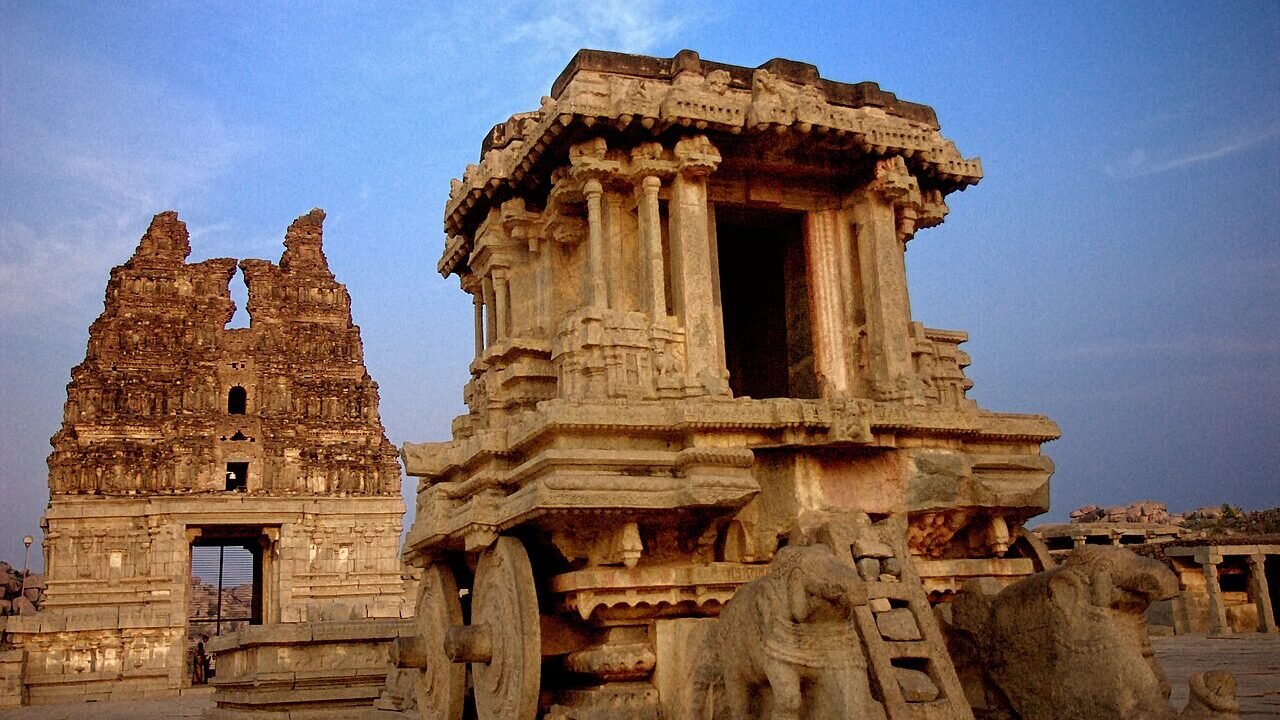
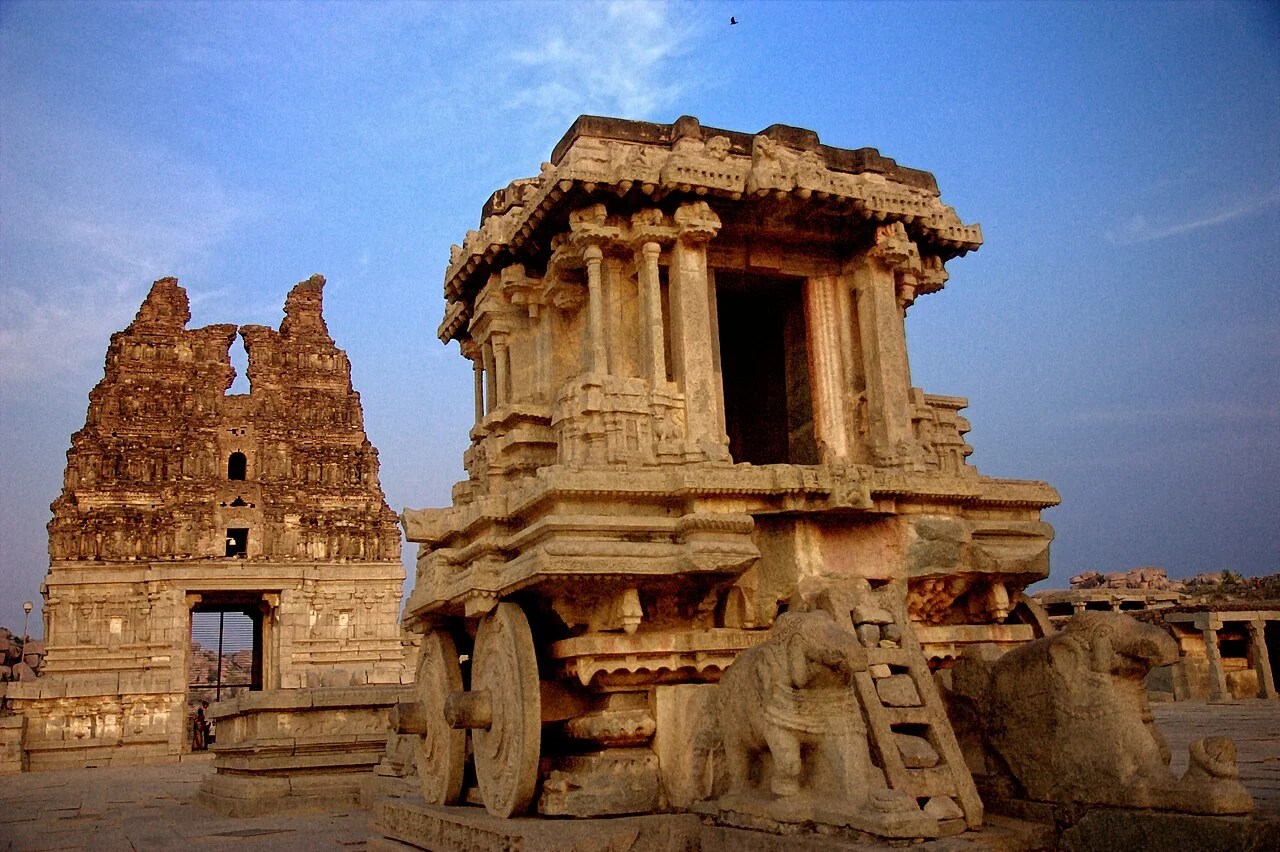
Go early. The Vijaya Vittala Temple is dedicated to Vittala, a form of Vishnu, and its courtyard holds the stone chariot, the emblem of Hampi. The Ranga Mantapa is described on the district tourism site as having 56 musical pillars that chime when struck; ask on site whether touching them is currently permitted. A roughly 2 km riverside path, Kampa Bhupa’s Path, links Hampi Bazaar with the Vittala complex, so you can walk back toward the village along the river.
Day 2: the sacred centre
Start at the Virupaksha Temple, dedicated to Shiva and described by several guides as still an active place of worship. Walk Hampi Bazaar, then climb Hemakuta Hill, where the Jain temples and the early shrines predate the Vijayanagara empire. In the late afternoon, Matanga Hill is the usual sunset viewpoint; one guide reports around 2,200 steps, so go prepared.
Day 3: the royal centre, and Anegundi if time allows
Visit the Lotus Mahal, a two-level pavilion with open arcades below and balconies above, whose cusped arches give it its name and reflect a blend of Hindu and Muslim architectural styles. Nearby are the Elephant Stables, a long pavilion that sheltered the royal elephants, and the Hazara Rama Temple. If you have time left, the village of Anegundi, across the river, is the other optional stop in Outlook Traveller’s itinerary. The Archaeological Museum is also worth a visit to understand the empire’s history.
About the stone chariot
The stone chariot is the most photographed monument in Hampi, and it appears on India’s ₹50 note. Guides commonly describe it as carved from a single block of granite, but art-historical accounts say its wheels were cut from separate blocks, so treat the “single block” claim with caution. The chariot is a shrine dedicated to Garuda, dated to the 16th century under the patronage of Krishnadevaraya. Its wheels were designed to turn but no longer move, and the elephants at the front replaced the original horses.
Sources used for this article: Outlook Traveller’s Hampi itineraries and architecture guide; the Vijayanagara district tourism pages (vijayanagara.nic.in); Wikipedia and Wikivoyage entries for Hampi; Rough Guides; hampi.in; the Impart Encyclopedia of Art entry on the stone chariot; and other travel guides cited by name above. Where accounts differ, the text says so. The photograph is used under a Creative Commons licence with credit shown beneath it.
Watch: Karnataka’s UNESCO heritage, including Hampi
Frequently asked questions
-
How many days do you need in Hampi?
Most guides recommend at least three days to see the main areas without rushing: the Vittala complex, the Virupaksha Temple and Hampi Bazaar, and the royal centre with the Lotus Mahal and Elephant Stables.
-
What is the best time to visit Hampi?
October to February (some guides say March) is the most comfortable season, with cool days and cooler nights. The Hampi Utsav is held in November or January depending on scheduling, so check the dates for your year.
-
How do I reach Hampi?
The nearest railway station is Hosapete (Hospet) Junction, about 12 to 13 km away, with frequent buses and cabs to Hampi. The nearest airstrip, Jindal Vijaynagar near Toranagallu, is about 35 to 40 km away with limited flights; Hubballi and Bengaluru are the main alternatives.
-
Why is Hampi a UNESCO World Heritage Site?
It was inscribed in 1986 as the Group of Monuments at Hampi, the remains of Vijayanagara, the capital of a major medieval South Indian empire, including temples, royal buildings, markets and fortifications.
-
Is the Hampi stone chariot carved from a single block?
It is often described that way, but art-historical accounts say its wheels were cut from separate blocks. The wheels were designed to turn but no longer move, and the elephants at the front replaced the original horses.
-
Is the Virupaksha Temple still in use?
Several guides describe the Virupaksha Temple, dedicated to Shiva, as still an active place of worship, with festivals and processions held there.