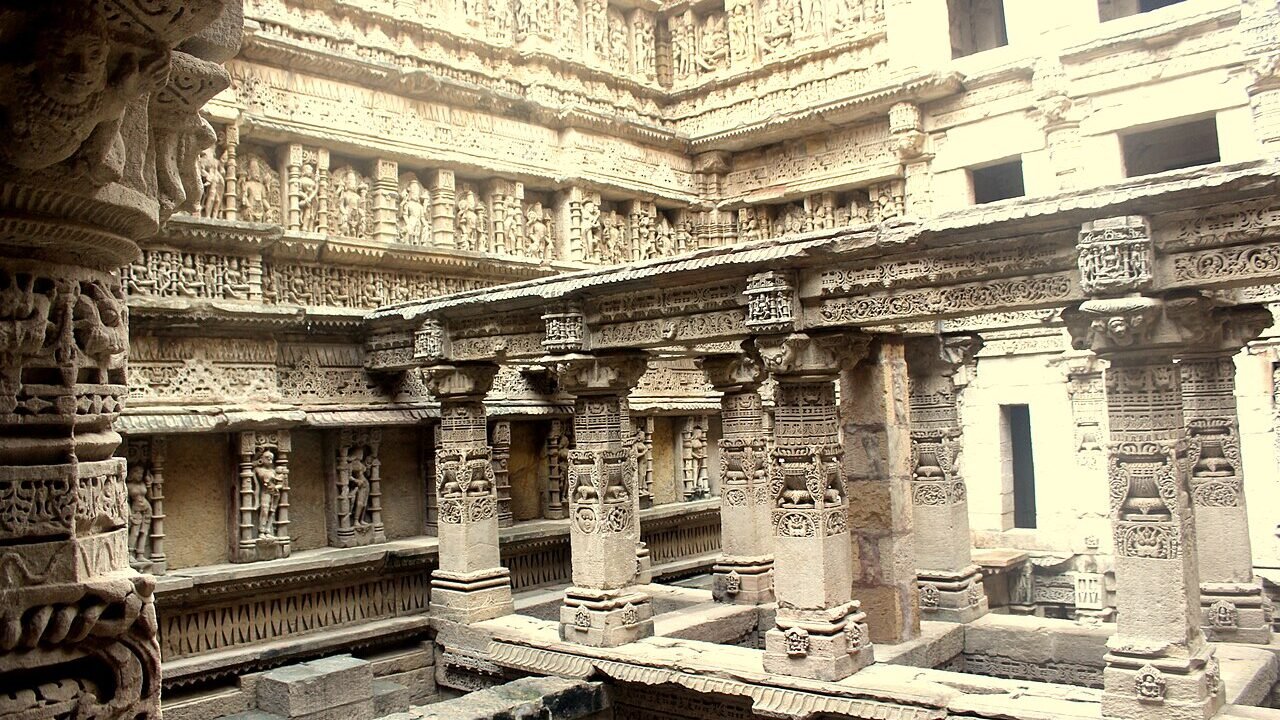
Rani ki Vav in Patan, Gujarat, looks unremarkable from the road: a flat, dusty plain. Then the ground drops away to a stone structure that descends seven levels below the surface, every wall covered in carved figures. It is a stepwell (a vav in Gujarati) built in the 11th century, and in 2014 it was inscribed as a UNESCO World Heritage Site. This guide covers what it is, why it survived, what to look for inside, and how to plan a visit.
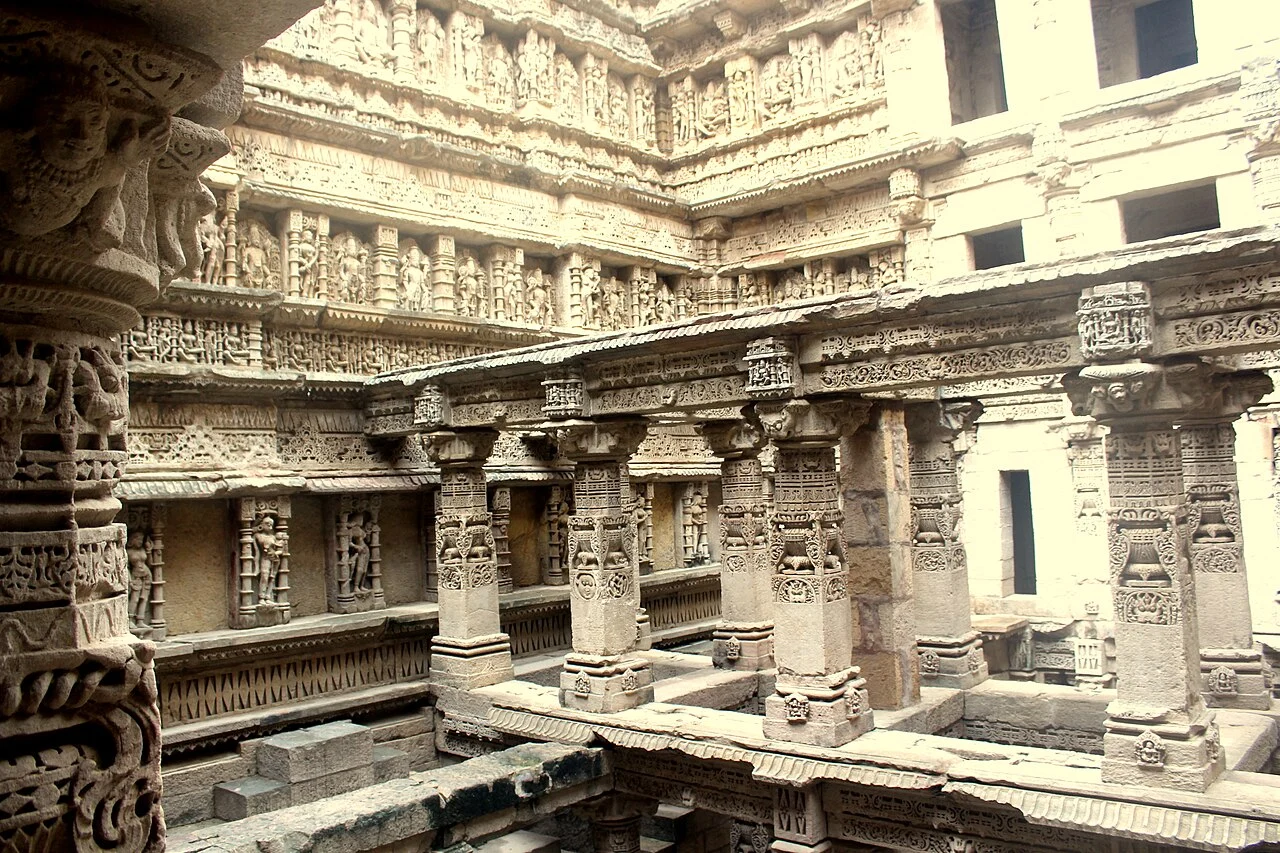
Rani ki Vav at a glance
| Location | Patan, northern Gujarat, on the banks of the Saraswati river |
| Built | 11th century, under the Chaulukya (Solanki) dynasty; usually dated c. 1050–1063 CE |
| Commissioned by | Queen Udayamati, in memory of her husband King Bhimdev I |
| Style | Maru-Gurjara architecture |
| Structure | Seven levels, designed as an “inverted temple”; roughly 64 m long, 20 m wide and 27 m deep (figures vary by source) |
| World Heritage status | Inscribed 22 June 2014 |
What is a stepwell, and why build one this elaborate?
In the dry parts of western India, a stepwell let people reach groundwater even when the water table dropped: instead of lowering a bucket, you walked down a flight of steps to the water. Stepwells were also places to rest and meet, and they often held shrines, so they served as water source, social space and sacred space at once.
Rani ki Vav takes that idea to its extreme. Its designers treated the well as an upside-down temple, with water as the sacred centre and the carved levels leading down toward it. In the classification used in medieval Indian architectural texts, it is described as a Nanda type stepwell, with a single entrance and three pavilion towers.
Who built it, and when?
Tradition credits Queen Udayamati with building the vav in memory of her husband, Bhimdev I, a ruler of the Chaulukya dynasty whose capital was Anahilavada Patan (modern Patan). A composition by the Jain monk Merutunga, dated 1304, mentions Udayamati as its builder.
Sources do not agree on every detail, and it is worth knowing where:
- The date. Some sources give c. 1050 CE, others 1063 CE. Both fall within or shortly after Bhimdev’s reign, so “the third quarter of the 11th century” is the safe description.
- Whether Udayamati was a widow. Many accounts describe her as a widowed queen, but historians dispute whether she commissioned it as a dowager, and some think it was completed by her and her son Karna after Bhimdev’s death.
How did it survive for centuries underground?
The Saraswati river flooded the vav and filled it with silt, and the structure eventually disappeared from view. Accounts attribute the end of its working life to floods and changes in the river around the 13th century. When the archaeologists Henry Cousens and James Burgess visited in the 1890s, it was buried, with only the shaft and a few pillars showing.
That burial is widely credited for the carvings’ excellent condition: the silt shielded them from weather and damage. One travel guide states that the Archaeological Survey of India excavated and restored the stepwell between 1981 and 1987. It also appears on the reverse of India’s ₹100 banknote, issued in 2018.
What to look for inside
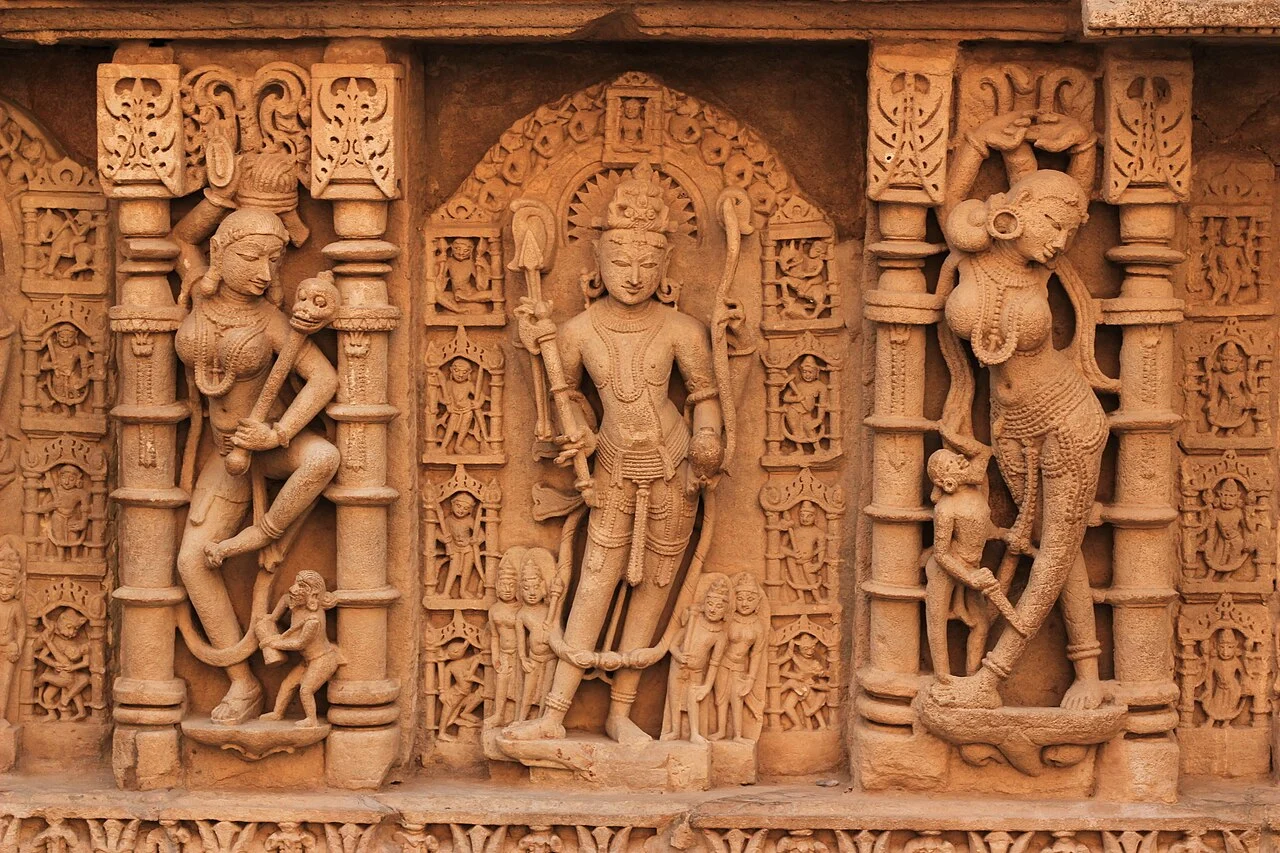
- The sculptural panels. Roughly 500 principal sculptures and about 1,000 smaller ones line the walls. Many depict forms of Vishnu, including his avatars such as Rama, Vamana and Kalki, along with Mahishasuramardini and celestial women (apsaras).
- The seven levels. Walk down level by level and notice how the pillared pavilions divide the large volume into smaller spaces; this is what makes it read as a temple rather than a well.
- The well shaft. The water tank and shaft are at the far end, below the last steps.
- The portrait of Udayamati. A carved image of the queen was recovered during the excavation.
A popular story says a 30 km tunnel from the base of the vav once led to the town of Sidhpur as an escape route for the king. This legend is widely repeated, but I could not find archaeological evidence for it, so treat it as local lore rather than established fact.
How to reach Patan
- By road: Patan is roughly 125–130 km from Ahmedabad. Travel guides quote about 2.5 hours by car; intercity buses are slower, at around 3.5 hours. Mehsana is about an hour away by bus.
- By train: Patan has its own railway station. Mehsana is the larger nearby junction.
- By air: The nearest airport is Ahmedabad.
Best time to visit, and planning tips
- Season: The Government of India’s tourism site names October to March as the most comfortable window for exploring.
- Time of day: Atlas Obscura recommends going in the morning, when it first opens.
- Evening shows: Gujarat Tourism advertises a 3D projection-mapping show and heritage lighting after sunset. Check current timings before you plan around it.
- Tickets and hours: These change, so confirm on the official Archaeological Survey of India or Gujarat Tourism pages before you travel. One traveller reports booking Rani ki Vav e-tickets in advance, so check whether online booking is available.
Pairing it with Modhera
Travel writers often pair Patan with the Sun Temple at Modhera, and the two are commonly done in a single day. Modhera was built under the same dynasty: an inscription dates it to 1026 CE, during the reign of Bhimdev I, the king Rani ki Vav commemorates. It is an Archaeological Survey of India–protected monument and, like the Sun Temple at Konark, is no longer a place of active worship. A travel log puts the distance from Patan to Modhera at roughly 35–40 km; confirm the route for your own plan.
Sources used for this article: UNESCO World Heritage listing information as summarised on Wikipedia; Gujarat Tourism’s Rani ki Vav and Modhera pages; the Government of India’s Incredible India page for Rani ki Vav; Atlas Obscura; and Outlook Traveller’s Gujarat guides. Where they disagree, the text above says so. Photographs are used under Creative Commons licences, with credit as shown beneath each image.
Watch: Rani ki Vav in 3D
Frequently asked questions
-
Where is Rani ki Vav located?
Rani ki Vav is in Patan, northern Gujarat, on the banks of the Saraswati river, roughly 125 to 130 km from Ahmedabad.
-
Who built Rani ki Vav and why?
Tradition credits Queen Udayamati of the Chaulukya (Solanki) dynasty, who built it in memory of her husband Bhimdev I in the 11th century. Historians debate the exact date, usually given as c. 1050 to 1063 CE, and whether she was a dowager at the time.
-
Why is Rani ki Vav a UNESCO World Heritage Site?
It was inscribed on 22 June 2014 as an outstanding example of stepwell architecture, designed as an inverted temple with seven levels and hundreds of detailed sculptures.
-
How is a stepwell different from an ordinary well?
A stepwell has flights of steps leading down to the water, so people can reach it even when the water table is low. Many were also gathering places with shrines.
-
What is the best time to visit Rani ki Vav?
October to March is named as the most comfortable season by India’s official tourism site, and Atlas Obscura recommends going in the morning when it first opens.
-
Is the 30 km tunnel to Sidhpur real?
It is a popular local legend, but no archaeological evidence for it is cited in the sources used for this article, so it is best treated as folklore.
-
Can I visit Modhera on the same day?
Many travel guides pair Patan with the Sun Temple at Modhera as a single day trip. A traveller’s log puts the distance at roughly 35 to 40 km, but check the route and opening hours for both sites before you plan.